Color Temperature
There is no "white" monochromatic light in nature. White light is a composite light formed by a mixture of various colors of light. Similarly, LEDs do not directly emit white light; instead, they generate "white" light perceptible to the human eye through specific optical techniques. The principle is that blue light emitted by the LED excites a phosphor layer to produce yellow light. The two colors mix to form white light. By precisely controlling the concentration and composition of the phosphor, different color temperatures of white light can be produced.
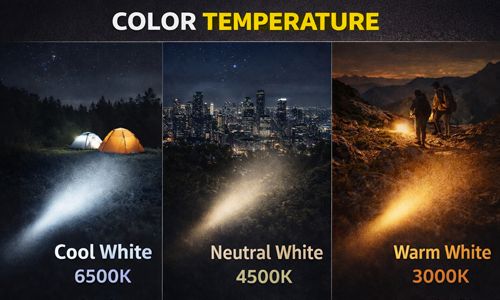
LED white light sources are generally available in three common color temperatures: Cool White Light (6,500K), Neutral White Light (4,500K), and Warm Light (3,000K).
- Cool White Light (6,500K) resembles midday sunlight and delivers high luminous efficiency with bright and attention-grabbing illumination.
- Neutral White Light (4,500K) is like early-morning daylight, providing soft, comfortable, and clear illumination that reduces visual fatigue over extended use.
- Warm Light (3,000K) is similar to incandescent lighting, offering longer wavelengths and stronger penetration, though with lower luminous efficiency.
For extended outdoor use, Neutral White Light is recommended. In environments where rain, fog, or snow frequently occur, lighting equipment with Warm Light is more suitable.